Current Layer
NEXUS Publication
The editorial and intellectual layer of the STS-IN platform.
NEXUS / Fieldnote
From Control to Co-Existence: Agency, Knowledge, and Insect Literacy at the Keet Saksharta Mission
An essay on insect literacy, local knowledge, and the shift from control logics to co-existence.
Author
STS-IN Contributor
Published
30 June 2024
Read
8 min read
Caroline Fazli
“Insects visit plants to help.”
This maxim, offered by an agroecological farmer in Igrah village, Haryana, initially appears counterintuitive within dominant agricultural discourse. Dominant pest-control narratives in agriculture frame insects as enemies to be eliminated, often using metaphors of war: pest ‘invasion’, crop ‘defense’, and ‘eradication’ of pests using chemical weapons.

Image of insecticide for sale from: https://www.indiamart.com/proddetail/ratnakar-war-insecticide-25324779012.html?srsltid=AfmBOorn49wos-88h6gzW3QCIetukCvejdIK_8R1liRChuV7u63Hoe84
This was our point of entry into the work of the Keet Saksharta Mission (KSM), a farmer-led initiative centered on what its members call insect literacy. What we encountered was not merely an alternative set of techniques for pest management, but a distinctive process of knowledge production in which farmers learn with insects, plants, and soils through sustained observation.
As Manbir Redhu, one of the movement leaders, put it while walking us through his field, “No plant grows without the ‘ijazat’ [permission] of the soil.”Weeds, insects, and crops are all part of an interconnected system, not isolated problems to be controlled.
At the KSM, insects are understood as indicators of ecological conditions. Their presence signals something about soil health, crop diversity, or imbalance created by chemical inputs. Rather than asking which pesticide to spray, farmers are encouraged to ask what the insects, plants and soil are communicating.
This reframing entails a subtle but consequential redistribution of agency. Instead of imagining crops as passive objects under assault and farmers as the sole decision-makers who intervene through chemical or technological means, plants and insects are understood as active participants in ecological processes that shape the conditions of the field. The farmer’s task is not simply to control but to interpret and respond to these interactions, to learn from and with plants, insects and soil.
The way in which KSM has engaged with agricultural science raises a broader question: does KSM represent a rejection of science, or participation in a reconfiguration of scientific practice itself? As a growing movement for farmer-to-farmer learning, the experience of KSM also raises questions about what ‘extension’ means in agriculture. In agricultural policy and development, ‘extension’ refers to institutional systems through which knowledge produced in research institutions is disseminated to farmers through training, demonstrations, and advisory services. The term therefore assumes that expertise originates in centralized scientific institutions and is then transferred outward to farmers. In this context, KSM’s practices raise questions about who is generating knowledge and whose knowledge is being ‘extended’.
Why Haryana Matters?
The significance of the KSM’s work becomes clearer in light of its location. Haryana has been closely associated with Green Revolution agriculture, characterized by monocultures, high levels of chemical inputs, mechanization and standardization. On the drive to Igrah village in December 2024, the landscape was dominated by uniform wheat fields, emblematic of a production-oriented model in which ecological diversity is often subordinated to an industrial conception of efficiency.
Against this backdrop, the farm we visited in Igrah presented a striking contrast: mixed cropping, diverse trees on the borders, and visible insect life. Yet the difference lay not only in agronomic practice but also in the interpretive framework through which the field was understood. Insects were not automatically read as threats, but as indicators of ecological conditions, and as participants in processes that could be interpreted and influenced without recourse to chemical eradication.
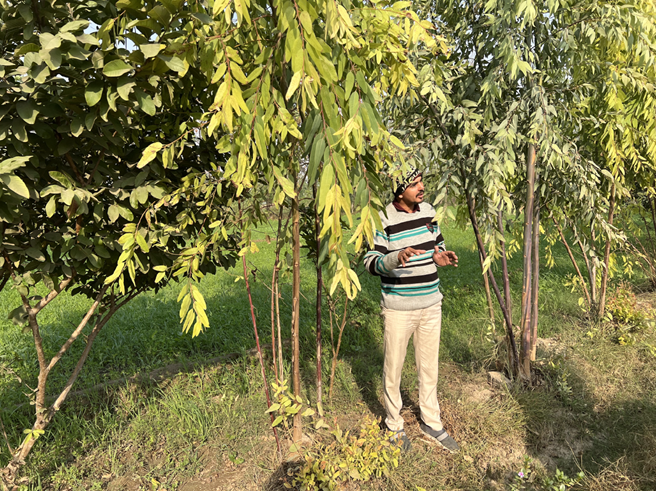
Dinesh Kumar, a farmer connected to Keet Saksharta Mission, introducing us to his family’s field.
As Manbir Redhu explained, the Keet Saksharta Mission has extended to address not just insects but an overall understanding of the dynamics of ecological interactions in the field, something which he feels, “The MNCs have not given us correct information about”. The KSM’s work opens up an ongoing dialogue with farmers on these topics. Still, they find that they must maintain regular phone contact with fellow farmers to allay the new fears continually created by agribusiness that suggest you cannot farm successfully without chemicals.
Lineages of Insect Literacy
KSM traces its origins to Dr. Surendra Dalal, a seed breeder whose engagement with insect literacy emerged in response to repeated outbreaks of American bollworm in cotton despite heavy pesticide use. Although trained in conventional agricultural science, Dalal began to question a narrowly input-dependent model of agricultural problem-solving. Working with farmers, he shifted attention toward ecological observation: insect life cycles, predator–prey dynamics, and seasonal patterns.
In Nidana village in 2008, Dalal and farmers documented over 200 insect species, distinguishing herbivorous (‘veg’) and predatory (‘nonveg’) insects. When the ‘veg’ and ‘nonveg’ insects are in balance, the ‘nonveg’ insects eat the ‘veg’ insects and prevent them from destroying the crops. Agrochemical application, however, kills off both types of insects in the short term, causing the next generation of insects to proliferate more in compensation for the previous generation’s shortened lifespan. This throws off the balance among insects and can lead to rapid crop damage. This research led to the proposition that insect literacy, not chemical warfare, was the key to breaking the cycle of pesticide dependency. Farmers shifted their focus to implementing ecological practices to help establish balanced insect populations on their farms.
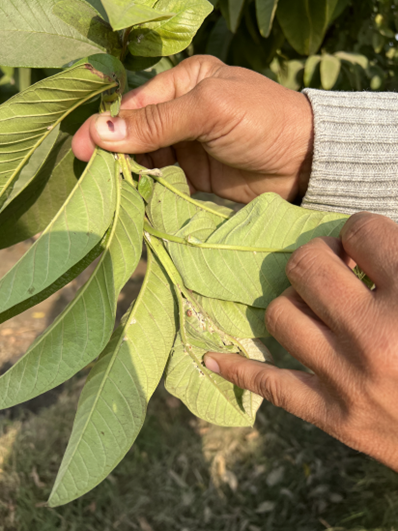
Photo of a KSM farmer showing the variety of insect life flourishing on the underside of a single leaf, featuring both veg and nonveg insects.
KSM’s practices align with contemporary findings in agroecology that have sought to better understand complex ecosystem dynamics on farms (Altieri, 1995). However, KSM does not regard the formal scientific establishment as sole authority of knowledge. While taking on some scientific inputs, KSM has also often challenged the findings of agricultural research institutions. Through paathshalas and collective field practices of observation and interpretation, KSM farmers function not as recipients of expertise but as knowledge producers, unsettling established boundaries between scientific and lay authority. This grassroots counter-expertise, however, operates under significant institutional constraints: even where KSM practices outperform conventional IPM approaches, recognition remains limited, as subsidies, extension systems, and agribusiness infrastructures continue to stabilize input-intensive models of agricultural science. KSM thus reveals how alternative ways of knowing are not only produced but also selectively authorized (or marginalized) within existing sociotechnical regimes.
These dynamics have implications for agricultural extension. Conventional models, such as Everett Rogers’ ‘diffusion of innovations’ framework (Rogers, 1983), assume knowledge is generated in research institutions and extended outward to farmers. KSM challenges this assumption. Knowledge about insects and crop health emerges through ongoing engagement with the field, with farmers as central analysts. The term “extension” itself becomes problematic: it presumes a stable body of knowledge at the centre. In KSM’s case, knowledge is continually produced through interaction with ecological processes. Rather than extension, what is occurring is a multi-sited collective process of learning.
Conversations Between Critical Agrarian Studies and STS
For scholars in critical agrarian studies, KSM’s efforts offer two critical inversions that can also be understood using concepts from Science and Technology Studies. First, agency is redistributed across humans and nonhumans; insects and plants are treated as participants in ecological processes rather than as passive matter, reflecting STS work on heterogeneous agency (Callon, 1984; Latour, 2005). Arguably, this inversion also carries a subtle but powerful feminist logic. Instead of the familiar story of an aggressive male pest attacking a passive female crop, the relationship is reframed: plants actively invite insects to fulfil ecological needs. The language of war is replaced by that of co-existence, mutualism, and participation.
Second, the hierarchy between scientists and farmers is unsettled, as farmers are positioned not as end-users of expert knowledge but as co-producers of it: rather than treating non-scientists as lacking knowledge, KSM recognizes forms of practical, ecological understanding that emerge through long-term engagement with land, crops, and environmental variability. The result is not simply broader participation but an expansion of what counts as legitimate knowledge. Whether this represents a transformation of science or an expansion of its boundaries remains an open question. KSM does not resolve issues of appropriation, authority, or epistemic justice, but it offers a situated example of how agricultural knowledge can emerge relationally—through interactions among diverse human and nonhuman actors—rather than through top-down prescription.
Conclusion: Rethinking ‘Extension’:
Perhaps what is needed is a shift from the language of extension to that of learning. Farmers, scientists, insects, plants, and soils participate in ongoing processes of inquiry. In a region emblematic of high-input agriculture, KSM’s work suggests that agricultural futures may depend less on intensified control and more on the capacity to interpret, respond to, and learn with ecological agency.
This raises questions about how such a collective process can be supported materially. The KSM relies on volunteer male and female farmer-trainers who facilitate the field paathshaalas while maintaining their own farms. However, it is a difficult and precarious path to sustain such an effort over many years. More consistent state and civil society support would be required not only to institutionalize farmer-to-farmer learning in agroecology, but also to enable the co-creation of knowledge on which this approach depends.
References
Altieri, M.A., 1995. Agroecology: The science of sustainable agriculture. Practical Action Publishing,. Available from: https://doi.org/https://doi.org/10.3362/9781788532310.
Callon, Michel, 1984. Some Elements of a Sociology of Translation: Domestication of the Scallops and the Fishermen of St Brieuc Bay. The Sociological Review, 32(1_suppl), pp.196–233. Available from: https://doi.org/10.1111/j.1467-954X.1984.tb00113.x.
Latour, B., 2005. Reassembling the social: an introduction to actor-network-theory. Clarendon lectures in management studies. Oxford: Oxford University Press.
Rogers, E.M., 1983. Diffusion of innovations. 3rd ed. New York: Free Press.
Caroline Fazli is currently working with the project, Participatory Action Research for Strengthening and Scaling Agroecological Transitions (PARSSAT), organized by the National Coalition for Natural Farming (NCNF), Shiv Nadar Institution of Eminence (SNIoE) and IRMA, with support from WASSAN and the Agroecology Fund (AEF). The project involves a group of practitioner-coresearchers in learning about approaches to farmer-to-farmer agroecology extension and agroecological scaling drawing on knowledge generated by farmers. As part of her doctoral research, she examined agroecological transitions, metabolic and epistemic rifts, and policy via an ethnographic study in Rayalaseema, Andhra Pradesh.
Suggested citation
STS-IN Contributor. “From Control to Co-Existence: Agency, Knowledge, and Insect Literacy at the Keet Saksharta Mission.” NEXUS, STS India Network, 30 June 2024.